Last updated November 17, 2026


Free written scope consultation - allowances, timeline, and change-order rules on paper before a single trade is scheduled
Driveway & Pavers Troubleshooting: Common Problems and How to Fix Them
If you’ve had a sunken paver re-leveled twice and it sank again, the paver was never the problem. In our experience across Doral, the repeat offenders are almost always a bedding-sand washout, a failed base layer, or a root pushing up from below – three different problems with nearly identical surface symptoms. Paying to reset the same stone a third time just resets the clock on the same failure. This guide teaches you to read the symptom and trace it to the actual cause, so the next repair sticks. You’ll learn how to tell those three failures apart, why white staining isn’t a cleaning job, how Doral’s drainage patterns drive edge rollback, and which temporary fixes are safe while you wait for a professional.
Quick Answer
Sinking or uneven pavers are rarely caused by the paver itself. In Doral, they almost always point to a bedding-sand washout, a base-layer failure, or a tree-root intrusion pushing up from below. Each one needs a different repair, and resetting the surface stone without fixing the layer underneath guarantees the problem returns.
Styles & brands we work with
- Kitchen remodeling
- Bathroom remodeling
- Home additions & ADU
- Roofing
- Windows & doors
- Driveway & pavers
- Fence
Table of Contents
- Reading the Symptom Before You Touch a Paver
- Washout vs. Base Failure vs. Root Intrusion: Tearing Them Apart
- Efflorescence: Why White Staining Isn’t a Cleaning Problem
- Edge Creep and Rollback Around Doral Homes
- Is That Cracked Paver Cosmetic or Structural?
- Safe Temporary Stabilizations Between Contractor Visits
- Common Mistakes to Avoid
- When to Call a Professional
Reading the Symptom Before You Touch a Paver
Every paver failure leaves a signature if you know how to read it. The mistake most homeowners make is starting with the visible stone instead of the pattern around it. Before you pull anything up, walk the area slowly and note three things: where the heaviest water sits, where the dip or hump begins, and whether the joints around it are still tight or have opened up. In Doral, our heavy summer downpours expose weak spots fast, so a low corner that gathers water is a reliable clue about what’s happening below.
Here’s the diagnostic sequence we use:
- Find the low spot. Pour a bucket of water across the area. Where it pools and stops moving tells you whether drainage is falling toward the house or away from it.
- Press at the edges of the dip. A soft, spongy give underfoot usually points to a washout – the sand has eroded and left a void.
- Check the joints. Wide, sandy, open joints near the low spot point to movement. Tight joints with a hump beneath point more toward root intrusion.
- Look up and around. A nearby tree, a downspout dumping onto the drive, or a slope change from a neighbor’s grading all narrow the diagnosis.
This walk-through takes ten minutes and tells you more than a contractor’s cold estimate. If you can describe the water pattern from memory, you’re already ahead of the conversation.
Washout vs. Base Failure vs. Root Intrusion: Tearing Them Apart
These three failures look almost identical from above, which is why so many Doral driveways get the wrong fix. The surface stone lifts or drops the same way in every case. What separates them is what sits underneath – and the repair cost is very different.
Bedding-Sand Washout
A washout happens when water finds a path through the joints and erodes the sand bed that sits between the pavers and the compacted base. It’s the most common cause of isolated dips in Doral, especially near downspouts and along the low side of a slope. The telltale sign is a soft, localized depression with open joints, usually within a few feet of where water exits the roof or runs off. This is the cheapest fix: lift the stone, re-screed the bedding, re-set, and re-sand the joints. But if the water source isn’t redirected, it comes back.
Base-Layer Failure
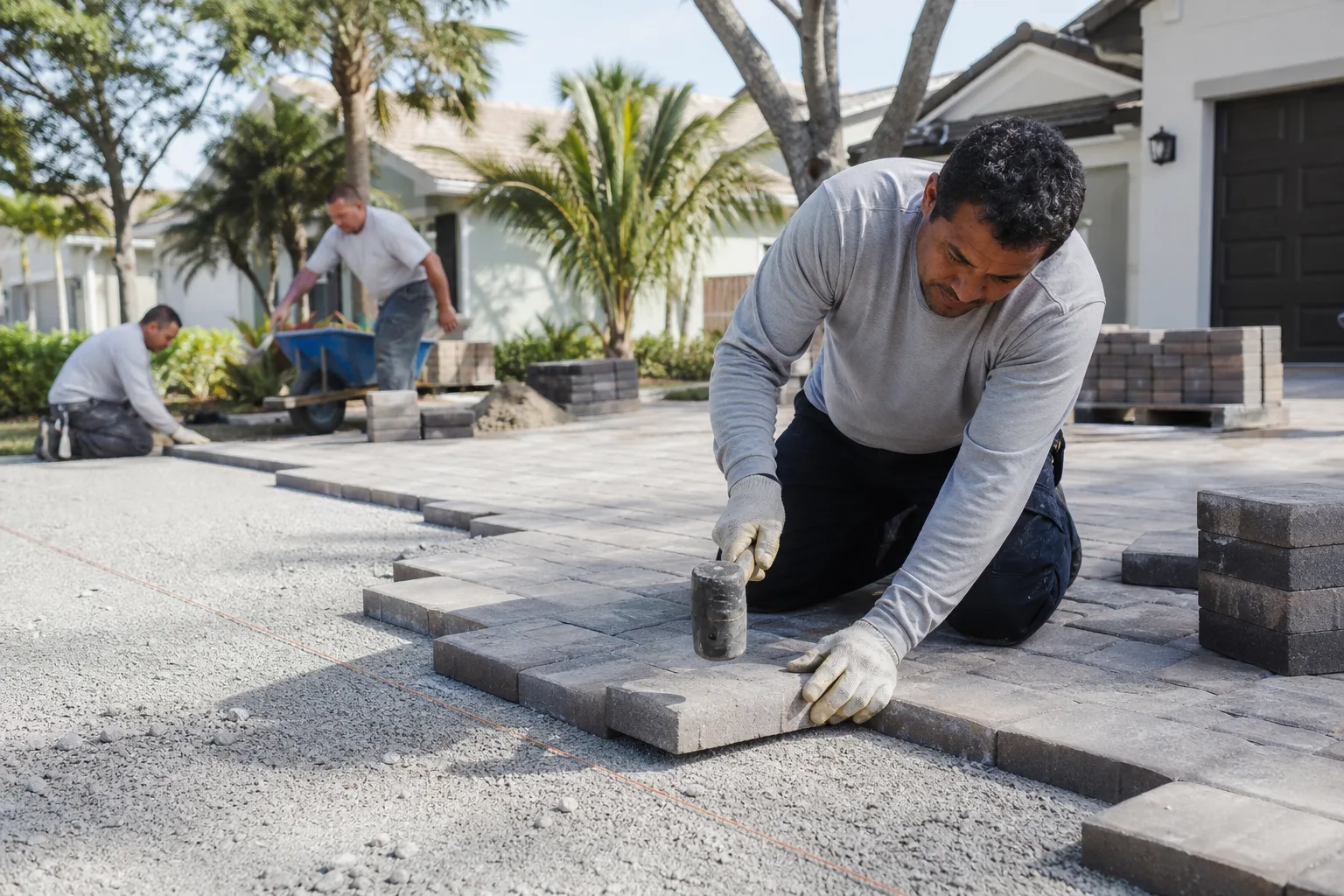
A base failure is the deeper problem. The compacted aggregate under the sand has settled, shifted, or was never properly compacted in the first place. You’ll see broad, shallow depressions that span multiple pavers, or a wavy surface that ripples across the whole drive. In our experience, base failures are common on Doral driveways laid over soil that was never graded for drainage in the first place. A proper repair means pulling a section, re-grading, and re-compacting the base – which is labor-intensive, but it’s the only fix that holds. Resetting the surface without touching the base is why so many homeowners pay twice.
Tree-Root Intrusion
Roots from nearby oaks, palms, and ficus hedges don’t just creep under a driveway – they lift it. The signature is a hump or bulge rather than a dip, often radiating out from a tree trunk or hedge line. The paver may tilt or crack. This is the trickiest case, because removing the root can harm the tree and the root will push back. A real repair involves a root barrier or, in some cases, rethinking the edge of the drive entirely. Ficus hedging around Doral properties is a frequent offender.
Efflorescence: Why White Staining Isn’t a Cleaning Problem
Those chalky white patches on your pavers aren’t dirt, and they aren’t mildew. Efflorescence is salt migrating to the surface as moisture moves up through the concrete and evaporates. It’s a moisture-below symptom, not a cleaning problem. Scrubbing it off works for a week; the stain comes back the moment water moves through again.
In Doral, with the humidity and the summer rain cycle, efflorescence shows up most on driveways with poor drainage or where irrigation sprinklers hit the pavers. The white powder is a message: water is entering the slab or base and working its way out through the stone. Sealing over it doesn’t fix the moisture. In fact, sealing a damp, actively efflorescing driveway can trap moisture beneath a film and make the problem worse – the salts push against the sealer from underneath.
What actually works:
- Find and fix the moisture source first – redirect sprinklers, correct the slope, or clear a blocked drainage path.
- Let the pavers dry thoroughly, ideally through a dry stretch of weather.
- Use an efflorescence-specific cleaner (not a general degreaser) if you want to remove the visible salt.
- Seal only after the moisture problem is solved and the surface has been dry for several days.
If the white staining keeps returning after you’ve removed it, that’s strong evidence the moisture is structural, and it’s worth a second set of eyes. A fresh driveway laid correctly with proper slope and base drainage shouldn’t bloom white repeatedly. If you’re considering a replacement rather than a repair, our Driveway & Pavers in Doral page walks through how a properly built drive handles Doral’s rain.
Edge Creep and Rollback Around Doral Homes
Edge creep is the slow migration of your border pavers outward, and edge rollback is when they tilt and drop at the perimeter. Both are structural edge-restraint failures, and Doral’s sandy soil and flat lots make them common. Without proper edge restraint, the pavers at the border of the drive have nothing holding them in. Each rain, each heavy vehicle load, and each thermal cycle nudges them a little further out. Over a season, the border loosens, the joints open, and the whole field starts to spread.
The reason this happens so often around Doral homes is the way water behaves on flat, sandy lots after a big storm. The soil under and around an un-restrained edge becomes saturated and soft, and the pavers migrate outward while the joints let in more sand and more water. That’s why edge restraint is the piece most worth getting right the first time.
Solutions that actually hold in sandy soil:
- Concrete edge restraint cast along the border, pinned into the compacted base – the standard for a permanent fix.
- Proper base compaction right to the edge, not just in the middle of the drive. The edge is where restraint starts.
- Drainage fixed before restraint. If water still flows toward the edge, no restraint will survive it long.
The wrong fix is a temporary border of loose stones or a strip of sand raked against the pavers. It looks fine after a week and rolls back within a season. Edge creep is also a reason not to trust a one-day driveway build that skips the compaction and restraint stages.
Is That Cracked Paver Cosmetic or Structural?
A single cracked paver in an otherwise stable drive is usually cosmetic and worth a clean replacement. A cracked paver next to a dip, a hump, or a radiating crack line is a structural red flag. The difference matters because replacing the stone without knowing which one you’re looking at just moves the problem a few inches over.
Run this test before you call anyone:
- Look at the crack pattern. One isolated crack in a field of intact pavers: cosmetic. Several cracks radiating from a single area: structural.
- Check the surface around the crack. If the pavers on either side are flat and level with the crack, it’s probably a load or impact crack. If there’s a slope, dip, or hump nearby, the base is the problem.
- Tap the stone. A hollow sound means a void beneath – likely washout or base settlement. A solid sound suggests the crack is surface-only.
- Look for movement after rain. Does the cracked paver shift or pump water when you step on it? That points to a base failure.
If the answer is structural, the cracked paver is the symptom, not the disease. Replacing it looks like a two-hundred-dollar repair and turns into a partial rebuild. Worth knowing before you start.
Safe Temporary Stabilizations Between Contractor Visits
There are a few things you can safely do to keep a problem from getting worse while you wait for a scheduled repair. There are also a few that quietly raise the final bill. Here’s the honest split.
Safe to do:
- Redirect a downspout so water stops dumping onto the dip area – a flexible extension can move the discharge ten feet away and slow the washout.
- Rake loose sand back into open joints at the edge of the drive to keep the water from undercutting the pavement further.
- Put something flat and rigid over a protruding paver in a walking path to prevent a trip – a rubber mat, not a loose brick.
- Take photos of the problem from the same angle each week. A photo log is genuinely useful when a contractor arrives.
Not safe, or makes the eventual repair costlier:
- Prying out pavers to “check the base” yourself – it’s easy to damage the stones, and you lose the joint pattern.
- Pouring bagged concrete or quikrete into a dip to fill it. The concrete sets unevenly and has to be broken out later. It can also trap moisture.
- Applying a sealer to a wet or actively efflorescing surface. You’ll trap the moisture and turn a cosmetic problem into a bigger one.
- Cutting out a raised paver over a root without a root barrier. The root pushes back within a season, and you’ve now created a gap the water will find.
The theme is simple: manage the water and document the problem. Don’t try to rebuild the base yourself. That’s the layer a professional tool and compaction plate is built to handle.
Common Mistakes to Avoid
- Re-leveling the same paver more than once. If a paver sinks twice, the surface isn’t the issue. Once you’ve reset it and it sinks again, the base or the water source is the culprit and re-leveling is a waste of money.
- Sealing too early or over damp stone. Many Doral homeowners seal a new drive the same week it’s finished. The base is still damp from construction and the seal traps moisture, which feeds efflorescence for months. Wait for a dry stretch.
- Ignoring the downspout. The single most common cause of localized washout we see around Doral is a roof downspout dumping onto the drive or against the edge. Moving it ten feet can cost fifty dollars and prevent a thousand-dollar repair.
- Judging a driveway by how it looks on day one. A properly built drive looks the same on day one and day six hundred. The failures show up after the first full rainy season, which is exactly when a one-day build gets exposed.
- Trusting an estimate that doesn’t mention the base. Any repair quote that only names “reset pavers and re-sand” is a surface fix. Ask what’s happening to the base underneath. If the quote has no answer, walk.
- Using landscape timbers as edge restraint in sandy soil. Timbers rot, shift, and don’t pin into the base the way concrete does. They look like a solution for one season and let the edge roll back.
- Skipping the permit conversation on a rebuild. If the repair involves re-grading or re-working drainage near the foundation or property line, ask whether a permit is required. On a fresh installation, permits should always be pulled – see our Barrett & Sons Construction Doral home page for how we handle permitting across trades.
When to Call a Professional
Call a professional when the same spot has needed re-leveling twice, when the dip spans more than a few pavers, when a root is lifting the surface, when the border has rolled back past its original line, or when efflorescence keeps returning after you’ve fixed the obvious water source. Those are the cases where a surface fix is throwing money at a layer that isn’t the problem. A base repair means pulling stone, re-grading, re-compacting, and re-setting – work that needs a plate compactor and a level that won’t lie to you.
Barrett & Sons Construction Doral offers free estimates in Doral – call (833) 734-5128. We’ll walk the drive with you, read the same water patterns you’re seeing, and put the scope in writing, including whether the base needs to come up. On any eligible job, permits are pulled and written change orders land before the work moves.
See the difference
 Before
 After
 Before
 After
 Before
 After
Frequently Asked Questions
Because the sinking paver is a symptom, not the cause. If the bedding sand or base layer underneath is washing out or settling, re-leveling the surface stone resets it for a few weeks and then it sinks again. The fix is to find and correct the water source and the base, not to keep lifting the stone.
It depends on which of the three failures you have. A localized bedding-sand reset is the cheapest fix, a partial base rebuild in the middle, and a root barrier plus edge restraint at the higher end – and Doral’s sandy soil and summer rain push many jobs toward the middle of that range. Call (833) 734-5128 for an exact quote – estimates are free, and we’ll tell you which layer is failing before we quote.
That’s efflorescence – salt migrating to the surface as moisture moves through the concrete and evaporates. It’s a moisture-below problem, not a stain you can scrub off permanently. Sealing over an actively efflorescing driveway traps the moisture and can make it worse. Fix the water source first, then clean and seal after a dry stretch.
If the crack is isolated in an otherwise flat, level drive, yes – carefully removing and setting one stone is doable. But if there’s a dip, hump, or radiating crack pattern nearby, the crack is a structural sign. Replacing the stone without addressing the base means the new stone cracks the same way.
For a simple reset or re-sand, usually not. For reconstruction that involves re-grading, drainage changes near the foundation or property line, or a full replacement, permits are typically required. We pull them and get inspections signed on every eligible job, and we’ll tell you upfront which category your repair falls into.
A properly installed driveway over a compacted base with proper edge restraint and drainage will hold up for decades, even through Doral’s summer storms. A one-day installation without proper compaction is the one that fails after the first rainy season. The base is what determines how long the drive lasts, not the surface stone.
The Bottom Line
Almost every driveway paver problem in Doral comes down to water and what’s happening underneath. Sinking, white staining, edge rollback, and cracked stones are symptoms – the real work is tracing each one back to a washout, a base failure, or a root intrusion. Fix the water source, fix the base where it’s failed, and stop paying for the same re-leveling job you’ve had done twice. If you’re not sure which failure you’re looking at, call and we’ll help you read it. But the wrong fix is more expensive than a diagnosis.
If your driveway’s problems are bigger than the pavers themselves – or you’re planning a new addition, a fence line, or a full rebuild – our Fence Installation in Doral and Home Additions & ADU in Doral pages show how we keep the same scope-in-writing, permits-pulled standard across every trade. Our technicians have up to 28 years of experience, and Tom Barrett publishes his name, his address, and his license number for anyone who wants to look it up before they sign.
Call (833) 734-5128 for a free estimate. We’ll walk the drive, tell you which layer is failing, and quote the repair in writing – with a written change order if the scope shifts after the stone comes up.
Written by the team at Barrett & Sons Construction Doral.